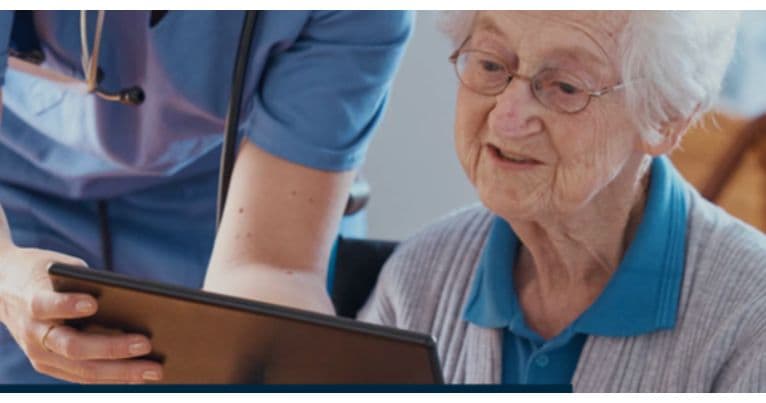
The future of the NHS will not be delivered by hospitals alone but will be shaped in people’s homes, communities and neighbourhoods, and these are the exact places where adult social care already operates every day.
That is the central message of techUK’s new white paper, Why digital adult social care transformation is central to the future of the NHS. The report makes a timely and important case: if the health and care system is serious about shifting from hospital to community, from analogue to digital, and from sickness to prevention, adult social care must be treated as a core part of the answer.
For too long, the narrative around social care has been more negative than positive. Social care has often been seen as downstream of the NHS, a service under pressure, rather than a strategic enabler of better outcomes across the whole system. techUK’s report challenges that framing and rightly so. Adult social care supports people across the whole of adult life, including older people, working-age adults with disabilities or long-term conditions, people experiencing multiple disadvantages, and those moving between services as their needs change. It is central to prevention, independence, discharge, community resilience and neighbourhood models of care.
A key point from the report is that much of the technology needed to support this shift already exists. Digital social care records, telecare, predictive monitoring, AI-enabled decision support and data-driven prevention are no longer theoretical. They are being deployed today across home care, supported living, day services and care homes but perhaps not always in the right way. The challenge has now shifted focus from invention and moved towards adoption, integration and scale.
Central to these conversations is building the right “coordination layer” around technology. Open standards, interoperability, shared assurance, outcome-based commissioning and better alignment between health, care, housing, local government and industry are all essential. Without addressing these fundamental factors, digital tools risk remaining fragmented, useful in isolation, but unable to transform care pathways at system level.
Data is often overlooked but its importance in delivering positive impact and outcomes in social care shouldn’t be underestimated. Used well, it can help care teams identify risk earlier, support more proactive interventions, reduce duplication and improve decision-making. But data must flow safely, appropriately and meaningfully between the people and organisations involved in someone’s care. It must also deliver practical value to frontline teams, not simply create additional reporting burdens.
The report also rightly highlights the role of industry. Technology suppliers are not peripheral to reform; they are key delivery partners. But for industry to contribute effectively, commissioners and system leaders need to engage early, specify outcomes rather than tools, and design digital requirements around real operational needs. Co-production and collaboration with people who draw on care, carers and frontline professionals is equally essential.
As a contributor to the techUK working group that helped inform the report, Blüm Health was pleased to support this important conversation about the future of digitally enabled social care. What stood out throughout the process was the importance of moving beyond technology as the starting point, and instead focusing on the conditions that allow digital services to work in practice.
This strongly reflects how we think about digital transformation. The most effective digital services are not built around technology for its own sake. They are designed around people, pathways, data flows, workforce realities and measurable outcomes. It’s also how we work in practice, for example we're working with innovators such as Amie Technologies to explore how technology can better support people receiving care at home. Patient- and family-reported insights are combined with clinical guidance and medical knowledge to give professionals earlier visibility of potential complications, enabling more proactive intervention, better symptom management and safer care outside hospital.
We also believe strongly that social care transformation should not be treated as a side issue in the future of health and care. It is one of the foundations on which a more preventative, connected and sustainable system will depend.
The opportunity now is to collectively turn this shared ambition into practical delivery: using digital innovation as an enabler of more proactive, personalised and joined-up care. As care continues to shift closer to home and into the community, technology can help services anticipate needs earlier, support people to live well and independently for longer, and give frontline teams the insight and tools to respond more effectively. The prize is better lives, more sustainable services and improved outcomes for the people and communities who rely on care most.
You can read techUK's report here