Imagine a scribe startup with a working product. Ambient voice capture, clean transcription, a tidy SOAP note at the end of every consultation. The team is weeks from a pilot when someone asks which regulatory pathway the product is being designed for. The room goes quiet and there’s an awkward silence.
The transcription itself was not the problem. Storing a word-for-word record of a consultation may be little more than a digital notepad. However, the summary was where things became more complicated.
If software is only helping a clinician document what happened, the regulatory position may be manageable. But if it starts selecting, structuring or interpreting patient-specific clinical information in a way that clinicians rely on for diagnosis, treatment, monitoring, triage or follow-up, the product may have crossed into medical device territory.
That one feature, the whole point of the product, could change the classification, the evidence burden, the review route and the launch timeline. Under EU MDR, for example, patient-specific decision-support software can fall into Class IIa or higher depending on its intended purpose and the clinical impact of the decisions it supports. The UK position needs to be assessed under the UK MDR and MHRA guidance, with further reform still evolving.
The startup team had not built a bad product but they had made a regulatory decision without knowing they had made one.
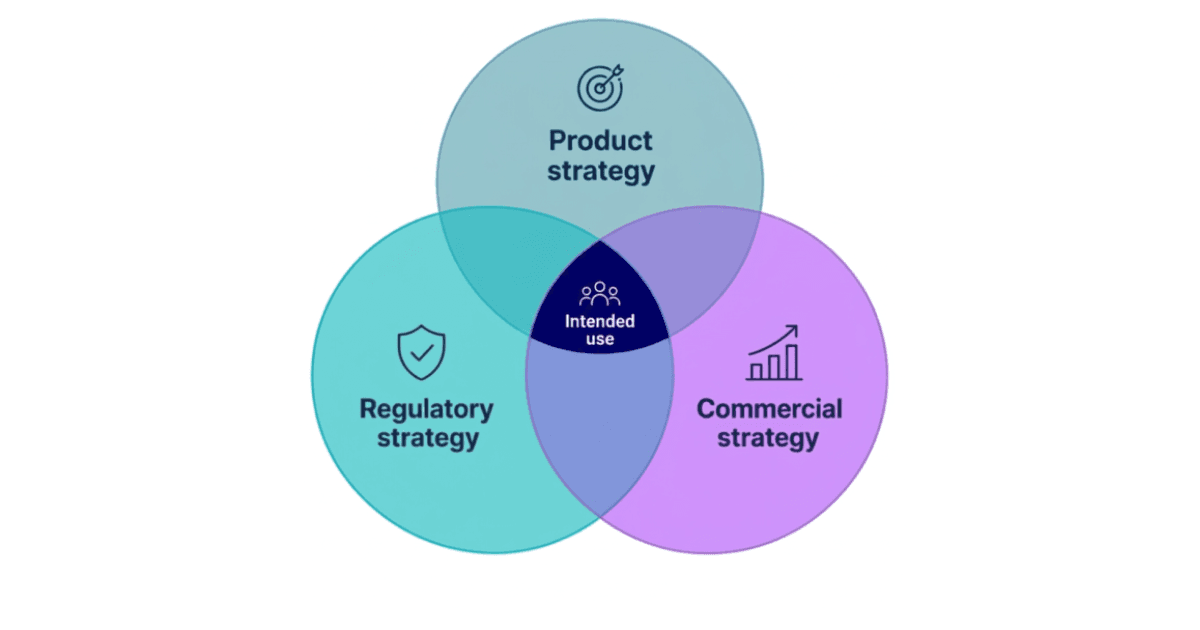
Intended use is the decision everything else hangs on
Classification does not come from what your software does under the hood. It comes from what you say it does, who it is for, what clinical context it sits in, and what decisions it is intended to support.
Regulators look at the intended purpose and apply the classification rules to that. Change the intended purpose and you may change the class. Change the class and you may have changed the evidence, the review route, the timeline and the cash investment you need before you can sell.
For a commercial team, intended use quietly sets four things that land on the balance sheet:
Which device class may apply, and therefore which regulatory route you are on.
How long that route may take.
What clinical evidence, technical documentation and external review you may need.
What version 1.0 can honestly claim, and what needs to wait for a later release.
So intended use absolutely cannot be something you write at the end. By the time you are drafting an intended use statement to fit the product you have already built, the expensive decisions may already have been made for you.
First question: is it even a device?
Before classification comes a simpler question: does the software count as a medical device at all?
Both UK and EU frameworks start with intended purpose. A product is not regulated as a medical device simply because it is used in healthcare, contains patient data, or uses AI. The question is whether the manufacturer intends it to serve a medical purpose.
That usually means functions connected with diagnosis, prevention, monitoring, prediction, prognosis, treatment or alleviation of disease, injury or disability. For software, the boundary often turns on two practical questions.
First: is the software doing more than storing, transferring or displaying information?
A system that stores notes, passes data from one place to another, or displays raw information may not be a device. But if it analyses, transforms or interprets patient-specific data for a clinical purpose, the risk changes.
Second: is the output about one specific patient?
General health information is usually different from patient-specific clinical reasoning. “People aged 50 with these risk factors have a certain chance of heart disease” is generic information. Calculating that risk for this patient, using this patient’s data, and presenting it to a clinician making a care decision is much more likely to be medical device software.
Here is the bit that we’ve seen many teams inadvertently trip over: intended purpose is judged by what you claim, wherever you claim it. That includes labelling, instructions for use, app store copy, websites, sales decks, demos, investor materials and customer onboarding.
A sentence saying “for information only” will not save you if the rest of your materials make clinical claims. You cannot disclaim your way out of your own marketing.
Same software, one feature apart
The easiest way to see the boundary is to watch products cross it. In each pair below, the product change may look small. The regulatory consequence may not be.
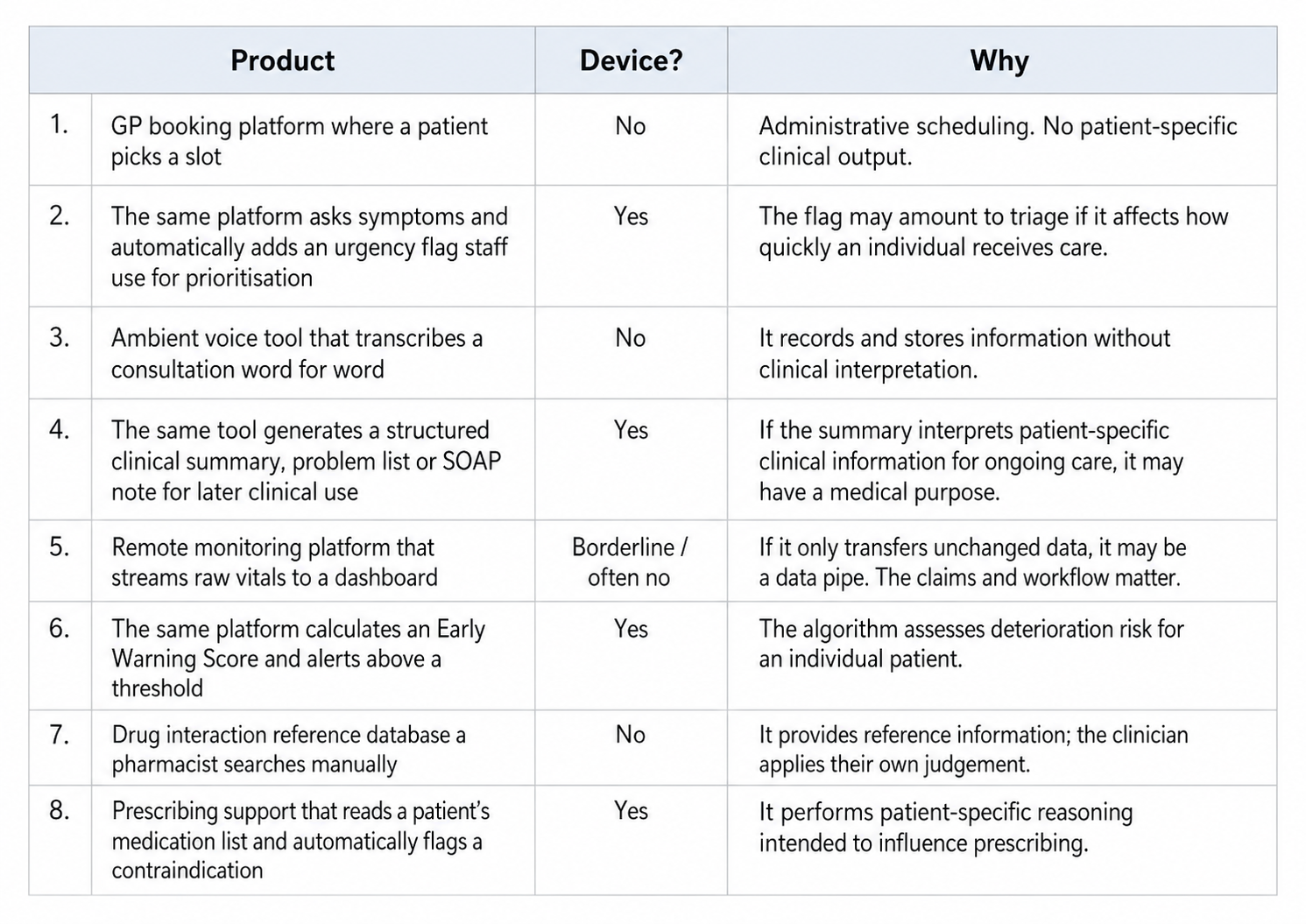
The key question is not whether the software or AI is used in a clinical setting. It is whether the software is intended to do something clinically meaningful with information about an individual patient.
Software that simply records, stores, displays or passes information along will often sit outside medical device regulation. Software that analyses patient-specific information to support diagnosis, treatment, monitoring, triage or prescribing is much more likely to be regulated, even if a clinician reviews the output before acting on it.
A living document, not a launch document
A product that ships outside medical device regulation, or as a lower-class device, can move as the roadmap changes.
The intended use is not locked at launch. It shifts whenever you add a feature, change the target user, enter a new clinical setting, or broaden the claims you make.
This is important because many health tech products evolve and drift from the original intended purpse. A tool starts as wellness, admin or documentation support. Then a release adds a disease-specific claim. Another adds a risk score. Another adds an alert. Another integrates with prescribing, referral or escalation workflows.
No one decides, in a board meeting, “we are now building a medical device.” The roadmap just gets there one sprint at a time.
That is why any feature that broadens your claims or changes the clinical role of the software should trigger a classification check before it is built. Not after a regulator, procurement team or investor asks the question.
Where regulation and engineering actually collide
Most regulatory advice stops at the rules. The harder question is what the rules mean for what you build, what you release first, and what you deliberately hold back.
If the AI summary creates regulatory uncertainty, could version 1.0 launch as transcription and documentation support while the clinical summarisation module goes through the right evidence and conformity work?
If the urgency flag is what turns a booking tool into triage software, is that feature core to the value proposition or can it be sequenced later?
If the remote monitoring dashboard is low risk until it generates alerts, do you release raw data first and build the alerting module under a separate intended use?
These are not just compliance questions, they are product, fundraising and go-to-market questions with regulatory consequences.
This is also where modular design matters. A platform may contain some functions that are medical device software and others that are not. If you can define the modules clearly, control the claims around each one, and sequence the evidence behind them, you have more strategic options.
If you cannot, the highest-risk feature may drag the whole product into a slower and more expensive pathway before the business is ready.
Claims control is product control
The intended use is not only written in the technical file. It is also implied by how the company talks.
That means claims control has to reach beyond regulatory affairs. Sales decks, demo scripts, website copy, procurement responses, onboarding materials and customer success playbooks all need to stay aligned.
A product team may think it is shipping “workflow support”. A sales deck may call it “automated triage”. A customer success manager may describe it as “detecting deterioration”. An investor memo may say it “reduces missed diagnoses”.
This may not sound like a big deal but those differences really do matter. The product you build, the claims you make and the evidence you hold need to stay in step. If they do not, the regulatory position becomes fragile.
The commercial point
The difficult part is not simply understanding the rules. It is making the right product decisions early enough, before the roadmap, evidence plan and market claims start pulling in different directions and this can be expensive and time consuming to rectify.
A thoughtful intended-use strategy gives you options. It can help you decide what to ship first, what to evidence next, what to modularise, what to avoid claiming, and when to deliberately step into a higher regulatory class because the commercial value justifies it.
The issue is not regulation itself. For health tech, regulation can be a mark of maturity and evidence that the product has been built with clinical risk, safety and accountability in mind. The issue is letting the product drift into a new regulatory position without making a deliberate decision about scope, evidence, timing and investment.
Intended use is not a paragraph you write before launch. It is one of the earliest product decisions you make.
Build the product and the regulatory strategy together
This is where we can help.
We bring a combination that health tech teams often need but rarely have in one place: practical product judgement, software delivery experience, and regulatory strategy for medical device software.
That means we do not just tell you what the rules say. We help you work out what they mean for your roadmap, your claims, your evidence plan and your commercial timing.
We can help you:
define an intended use that supports the business you are trying to build;
assess whether your software is likely to be a medical device;
understand how specific features may affect classification;
decide what to ship first, what to evidence next, and what to hold back;
align product, engineering, clinical, commercial and regulatory teams before expensive decisions are locked in.
The goal is to make the regulatory pathway a conscious commercial choice: timed around the right product scope, supported by the right evidence, and aligned with the market you want to enter
If you are building health software and are not sure whether your next feature changes the regulatory picture, we can help you make that decision before the roadmap makes it for you.